
IFN Staff
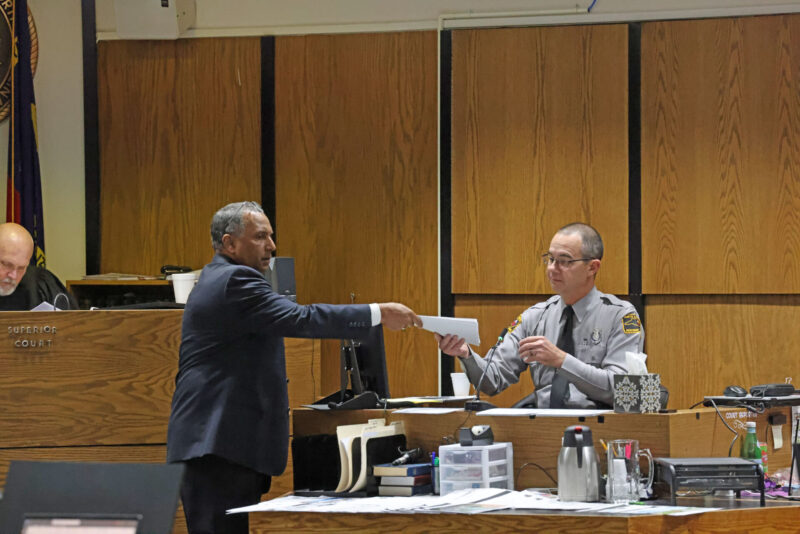
A member of the N.C. State Highway Patrol Collision Reconstruction Unit testified on Tuesday that his analysis of the scene of a deadly collision near Statesville did not support the explanation provided by the man accused of causing the crash.
During the course of more than four hours on the witness stand in the Iredell County Superior Court trial of Austin Ray Harmon, Trooper David Reid described for the jury his meticulous work over two days documenting all of the evidence at the scene of the June 13, 2022, crash on Fort Dobbs Road.
Harmon, now 26, was driving a Honda Accord that was traveling west on Fort Dobbs Road when it collided with a golf cart occupied by six people in the eastbound lane about 9:30 p.m., according to witness testimony. Michael Marlowe, who was driving the golf cart, was fatally injured, along with his 5-year-old son Bentley and 13-year-old daughter Jada. Marlowe’s fiancée, Amy Mills, their 2-year-old daughter Bailey, and a 16-year-old family friend, Teagan Murphy, were all seriously injured. Harmon is charged with three counts of felony death by motor vehicle, three counts of serious injury by motor vehicle, DWI and reckless driving in connection with the crash.
In an unrelated matter, Harmon was charged with possession of a small amount of a controlled substance in the Iredell County Detention Center on Monday night. Possession of any quantity of a controlled substance in a local jail is a felony under N.C. law. Harmon is scheduled to make a first appearance on that charge and two related misdemeanor charges in District Court on Wednesday morning before his trial in Superior Court resumes.
Tuesday marked the fourth day of testimony in Harmon’s trial. The session opened with Assistant District Attorney Mikko Red Arrow calling the state’s 13th witness. Fort Dobbs Road resident Steven Johnson told the jury that he heard a loud noise outside his home as he was preparing for bed about 9:30 p.m. on June 13, 2022.
After going outside, Johnson saw crash debris and a body in the road before encountering Harmon, who was holding a small child who had sustained a head injury.
Harmon told him, “I didn’t see them,” according to Johnson’s testimony.
The witness also testified that he had observed the golf cart traveling on Fort Dobbs Road on five or six other occasions, including once after dark. “It looked like an extremely old golf cart, and it didn’t go very fast,” Johnson said, adding that its headlights were “extremely dim.”
During his three- to four-minute encounter with Harmon, the defendant’s speech was not slurred and he did not stumble or smell like alcohol, Johnson told the jury, offering an assessment that resembled the earlier testimony of several first responders.
“With the little time I spent with him, I’d say he seemed like he wasn’t impaired at all,” Johnson said.
According to earlier testimony, Harmon’s breath tested positive for alcohol at the scene, a field sobriety test performed by a trooper indicated impairment, and an analysis of the defendant’s blood taken after his arrest revealed he had a blood alcohol concentration above the legal limit. He also had traces of a prescription painkiller and THC in his blood, a trooper told the jury.
During Trooper Reid’s testimony on Tuesday, Assistant District Attorney Mikko Red Arrow introduced nearly 100 exhibits, including photos, diagrams and videos documenting the location of Harmon’s Honda and the golf cart at the moment of maximum impact as well as the significant damage to both vehicles.
The location of skid marks from the Honda, gouge marks in the asphalt, and fluid trails left by both vehicles proved that Harmon’s westbound vehicle crossed into the eastbound lane and collided with the golf cart, the trooper said.
“There’s no doubt in my mind” that the accident occurred in the eastbound Lane, Reid testified.
The mass and speed of the Honda, which was traveling at about 40 mph, resulted in the transfer of a significant amount of kinetic injury from the sedan to the much smaller golf cart, causing catastrophic damage to the golf cart, the trooper said, comparing it to a 250-pound football player hitting a 17-pound toddler.
All six occupants of the golf cart were ejected.
After the impact, the fluid trail from the Honda began in the eastbound lane and then crossed back into the westbound lane, leaving a trail measuring approximately 600 feet that ended where the Honda was stopped after the crash, Reid testified. A second fluid trail showed the path that the mangled golf cart took before coming to rest on the north shoulder of Fort Dobbs Road, he added. The top of the golf cart, which was sheared off, was found in the middle of the road and small parts were littered throughout the crash site.
In addition to the damage to the Honda and the golf cart, the prosecutor also introduced photos showing the fatal injuries that Michael and Bentley Marlowe suffered. The father’s body came to rest on the back of the Honda and his 5-year-old son’s body was found in the middle of the road. Jada Marlowe died about a week after the crash after a breathing machine was disconnected when tests indicated she had no brain activity, according to earlier testimony.
After Trooper Reid marked the scene and used a GPS system to create a precise scaled diagram of the crash site, he conducted a nighttime driving study to determine if the evidence supported Harmon’s version of the crash. The defendant maintains that he was traveling west at about 40 mph when the golf cart pulled out in front of him from a grassy area on the north side of the road before he swerved to avoid hitting it.
Reid, who has been assigned to the NCSHP’s Collision Reconstruction Unit since 2017, worked with two other troopers in an effort to determine the approximate distance from which Harmon could have seen the green EZ Go golf cart in the dark roadway as he approached the impact site in his Honda Accord.
The study factored a speed of 35-40 mph and included four different scenarios, including one when the Honda had its high beams on and the golf cart had no headlights, one in which the Honda had its high beams on and the golf cart had lights on, one in which the Honda had its low beams on and the golf cart had no headlights, and one in which the Honda had its low beams on and the golf cart had its headlights on. The prosecutor showed the jury videos showing all four scenarios.
Based on normal human reaction times and several factors that were working against Harmon at the time and site of the crash — including darkness, the curve in the road, and Harmon’s impairment due to his alcohol consumption, the study assumed response times of 1.5 seconds and 2.0 seconds.
Considering all four scenarios and those response times, Reid told the jury that he had concluded that Harmon could only have seen the golf cart in time to swerve into the eastbound lane in time to reach the impact site if he had been traveling with his high beams on and the golf cart had functional headlights.
But even then, the trooper testified, Harmon could not have navigated the turn on Fort Dobbs Road just prior to the impact site, swerved to his left and kept the Honda on the road without considerable skidding. The actual skid marks from the Honda began after the impact site and were in a straight line on the outside of the eastbound lane, according to photos from the scene.
Trooper Reid’s testimony will continue on Wednesday morning when the defense team of Kaleigh Darty and Ken Darty will have an opportunity to cross examine him. The medical examiner is also expected to testify.
Judge Thomas Lock earlier told the jury of seven men and five women and two alternates that testimony in the case could conclude as early as Tuesday, but it now appears that testimony will stretch into Thursday.
The defense team has not indicated whether Harmon will take the witness stand.