
IFN Staff
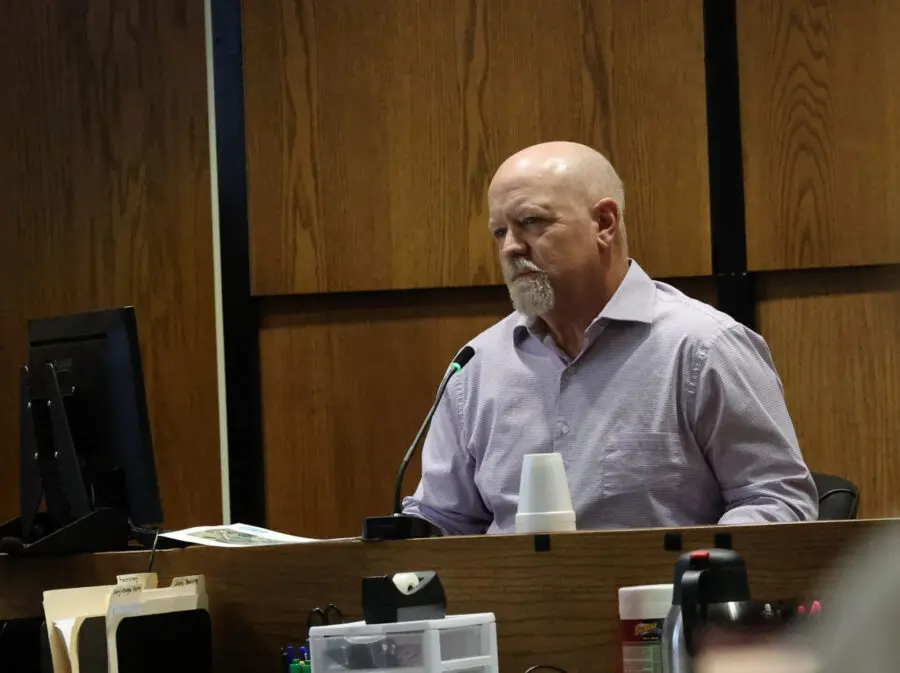
A man who was traveling on Fort Dobbs Road behind Austin Ray Harmon on the evening of June 13, 2022, when Harmon’s Honda Accord crashed into a golf cart testified in Iredell County Superior Court on Thursday about what he observed before and after the deadly collision.
While driving home with his wife after eating dinner at Mi Pueblo restaurant, Jeff Brooks was about 150 feet behind the Honda in the westbound lane in his Ford F-150 pickup when the sedan “made a hard cut to the left,” Brooks told the jury. “That is what got my attention.”
The next thing he saw was the roof of a golf cart — which he initially thought was a table — flying over the Honda. Then he saw the head and chest of a man and then a teenage girl falling, Brooks testified.
Prior to the crash, as he followed the Honda, he never saw the vehicle drive erratically — and he never saw the golf cart or its headlights, Brooks said in response to defense attorney Ken Darty’s questions during the sixth day of testimony in Harmon’s trial.
Harmon, now 26, is charged with three counts of felony death by motor vehicle, three counts of serious injury by motor vehicle, DWI and reckless driving in connection with the crash. Michael Marlowe, who was driving the golf cart, was fatally injured in the collision, along with his 5-year-old son Bentley and 13-year-old daughter Jada. Marlowe’s fiancée, Amy Mills, their 2-year-old daughter Bailey, and a 16-year-old family friend, Teagan Murphy, were all seriously injured.
Harmon, in a 9-1-1 call minutes after the crash and in the written statement he gave state troopers at the scene of the crash before being charged with DWI, claims he drove into the eastbound lane of travel in an attempt to avoid hitting the golf cart, which he said pulled onto the road in front of him from a grassy area on the north side of Fort Dobs Road.
Assistant District Attorney Mikko Red Arrow, who is prosecuting the case, contends that Harmon was legally impaired, which caused him to drive his vehicle across the centerline and crash into the golf cart. A trooper assigned to the N.C. State Highway Patrol’s Collision Reconstruction Unit testified earlier this week that there was no doubt in his mind that the crash occurred in the eastbound lane. He also told the jury that, in his opinion, the evidence did not support Harmon’s version of the crash. His conclusion was based on physical evidence collected at the scene and on a nighttime visibility study the NCSHP conducted on Fort Dobbs Road months after the crash.
After the prosecution rested its case in chief Thursday, Brooks was the first witness called by the defense team of Kaleigh Darty and Ken Darty. Brooks’ testimony was consistent with two written statements he gave to troopers after the crash as well as a recorded phone interview with a trooper that the jury heard on Thursday.
Brooks, who owns a small trucking company, told the jury that he initially thought the Honda had possibly hit some trash in the roadway. But he soon realized it was “some type of accident” when he saw one of the teenage girls’ face “roll in the road.”
Brooks got out of his truck to see if he could help the people involved in the crash, and his wife called 9-1-1 to report the crash. He found Jada — who died about a week after the crash — first. “I could tell she was hurting,” he told the jury. “She was in distress.”
Nearby, he found Teagan and then Amy, who made eye contact with Brooks and responded to him despite suffering from a traumatic amputation of one of her legs below the knee and several other serious injuries. Further west on Fort Dobbs Road, he found Bentley, who he said was obviously deceased.
“I actually told my wife to stay in the truck,” Brooks told the jury. “I didn’t want her to see what I’d seen.”
Brooks said he stayed with Jada and his wife remained with Teagan while they waited for emergency medical personnel, firefighters and law enforcement to respond to the scene. “It seemed like forever,” he said.
When a woman who had some medical training arrived, Brooks said he directed her to help Amy. She, in turn, asked Brooks to go check on the individual who was on top of the car. As he was walking down the road to the Honda, which was about 600 feet away from the site of the crash, Brooks encountered Harmon, who was carrying Bailey. The 2-year-old was bleeding from the head and crying.
“He kept saying, ‘Oh, no. Oh, no,’ ” Brooks testified. “That’s really all he said at that point. He just seemed to be upset because the people that were injured.”
During the 30 to 40 minutes that Brooks estimated he spent with Harmon, he saw no signs of impairment, according to his testimony. The defendant’s speech was not slurred, he had no trouble walking or standing up, and Harmon did not smell like alcohol or marijuana, Brooks added.
At some point, Brooks said later in his testimony, Harmon shared what he said happened right before the crash.
“He said, ‘All of a sudden they were there. They came from the right side of the road, and they were there,’ ” Brooks told the jury.
Although Brooks provided a written statement that night, he said he contacted the NCSHP the following day because the information published in the local newspaper that was attributed to a trooper who was at the scene of the crash was inaccurate.
“It was wrong. It was completely wrong,” Brooks told the jury. “It wasn’t what I saw” that night.
Earlier Thursday, the prosecutor rested the state’s case in chief after questioning his last two witnesses, a forensic toxicologist and medical examiner. Red Arrow also briefly recalled Mills to the stand for the purpose of introducing another photo of her 2-year-old daughter’s facial injuries.
Kari Tabor, who works as a toxicologist in the N.C. State Crime Lab, told the jury that an analysis of blood drawn from Harmon after his arrest revealed he had a blood alcohol concentration of 0.12, which is above the legal limit for impairment. Additional lab tests also showed the defendant had a prescription painkiller and THC, the active ingredient in marijuana, in his blood. Individually, all three substances could depress the central nervous system, causing impairment, Tabor said, and the combination of the three could cause increased impairment.
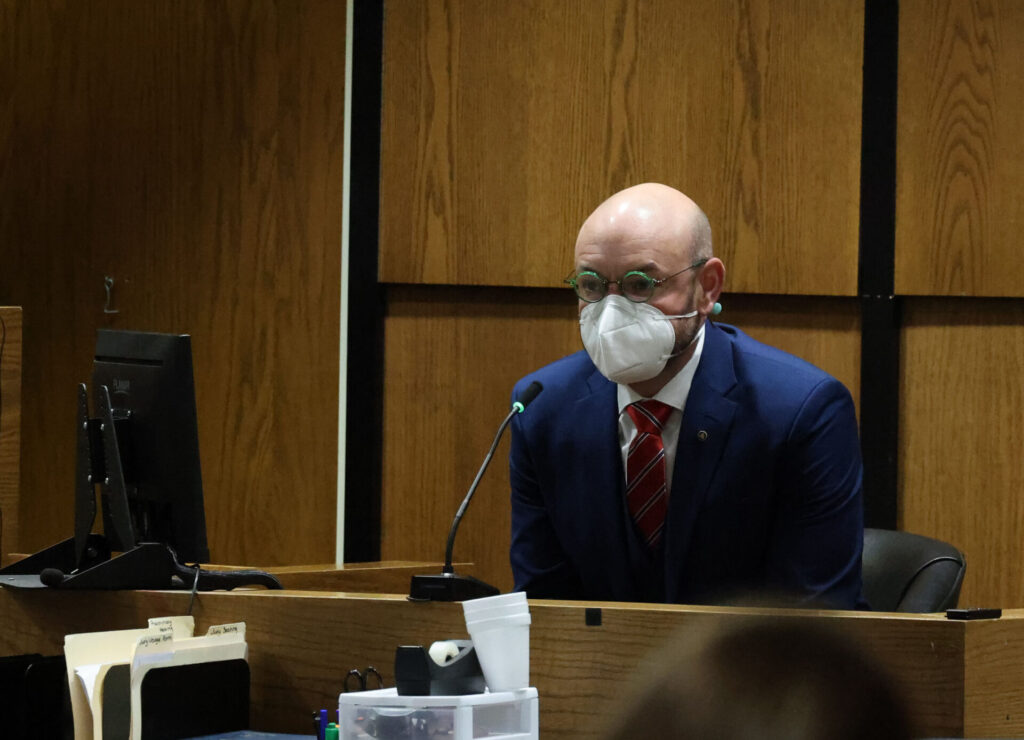
Medical examiner Justin Moore testified that Michael Marlowe and Bentley Marlowe both died as a result of blunt force trauma. Those determinations were made after he reviewed their bodies at a local funeral home. North Carolina law does not require an autopsy to be performed on individuals who die in motor vehicle crashes if the cause of death is obvious, Moore told the jury.
During cross-examination, the medical examiner told the jury that he was unable to draw blood from Michael Marlowe’s body because his body had already been embalmed when Moore arrived at Nicholson Funeral Home to conduct his examination at 5 p.m. the day after the crash.
The defense team challenged that testimony, introducing as evidence funeral home records that indicated Moore did not arrive at the funeral home until 7 p.m. The medical examiner said he would not dispute the funeral home’s report of his arrival time, but he was adamant that the body had already been embalmed and that there was no use attempting to draw blood for toxicology screening.
The defense team has implied that Michael Marlowe may have been impaired while driving the golf cart, which was not equipped with basic safety limit such as seat belts and brake lights, was not registered and could not legally be operated on a state road. Marlowe drank most of a 32-ounce beer at Mi Pueblo restaurant between 8:13 p.m. and about 9 p.m. on the night of the crash, according to witness testimony and photographic evidence. The crash occurred around 9:30 p.m.
Over the course of six days, the prosecutor called 16 witnesses to the stand and introduced 150 exhibits, including photos of the crash scene and the injuries suffered by the occupants of the golf cart, as well as medical records first-responder reports, and audio and video recordings of witness interviews.
Also on Thursday, outside of the presence of the jury, Red Arrow was unsuccessful in his effort to introduce evidence related to a single-vehicle crash involving Harmon that occurred in Troutman more than three years after the crash on Fort Dobbs Road. Judge Thomas Lock ruled that the crashes were not similar enough or close enough in time to justify inclusion and that the evidentiary value would have been outweighed by unfair prejudice to Harmon. The fact that law enforcement did not submit evidence to the crime lab did not help the prosecution’s effort.
Testimony is scheduled to resume Friday morning, when the defense team plans to question a witness who claimed in a recent social media post that he saw Michael Marlowe operating the golf cart in an unsafe manner on Fort Dobbs Road on the night before the fatal crash.
Closing arguments and jury deliberations could begin Friday, but the judge also said there was a chance the panel of seven men and five women would not get the case until Monday.