

A finger swipes up, a screen flashes, and a person in a subway car smiles at a three-second clip of a cat. Digital life has shrunk to the size of a coffee break. Now, this transformation has reached the world of games. If a player cannot understand the rules and win within half a minute, they simply
close the tab. This is the era of micro-doses of dopamine.
The Mechanics of Instant Satisfaction
Modern attention is a scarce resource. People no longer want to spend forty minutes on a tutorial just to learn how to move a character. They need a click, a visual response, and a result. This process resembles a mechanical stopwatch: start, action, finish. It fits perfectly into the gaps between real-life tasks. While the kettle boils or the elevator descends, a person manages to complete a full cycle of a game session.
The demand for such experiences has shaped an entire niche of platforms where simplicity is the main feature. For instance, finding a quick Chicken Road challenge or a similar obstacle-based sprint allows a user to test their reaction without any long-term commitment. These sites focus on a clean interface and immediate access. A player enters the page, sees the path, and starts moving.
No complex registration forms, no heavy loading screens. It is about the pure mechanics of the moment, where the interface stays out of the way of the process.
This shift toward ultra-short sessions is driven by specific psychological triggers that keep the brain engaged without causing fatigue:
● The feedback loop is nearly instant. A win or loss happens so fast that the brain does not have time to build up stress.
● Visual cues are simplified. Bright colors and clear shapes replace complex textures to prevent sensory overload.
● The restart button is the most used element. The friction between losing and trying again is reduced to a single tap.
Sensory Response and Physicality
There is a strange satisfaction in the way a button clicks on a glass screen. Developers of micro-games spend hours perfecting the vibration and the sound of a successful move. It is not just code. It is the cold touch of the smartphone and the haptic buzz that tells the hand: something happened. This physical connection makes a thirty-second session feel real. When the game is over in seconds, every detail matters. The way a character falls, the slight delay before a reward appears, or the sharp sound of a countdown. These elements turn a simple algorithm into a ritual. It is similar to the sound of a soda can opening. People do not just want the drink. They want the “pssh” sound that comes with it.
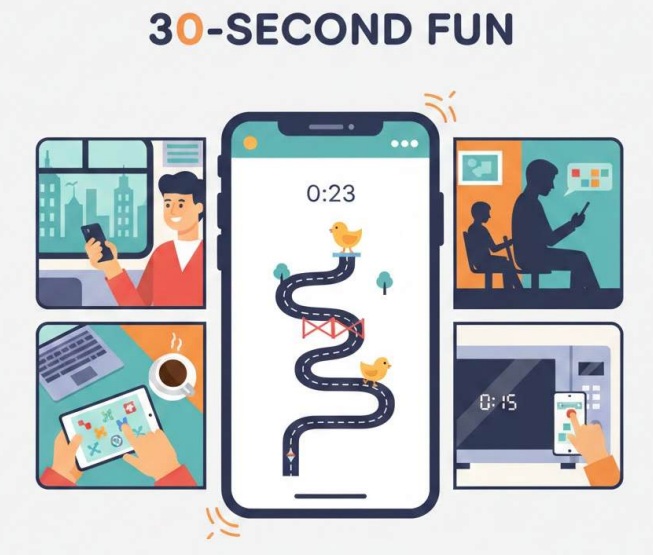
To understand why this works, one can look at the typical environment where these games are played:
1. Public transport. High noise levels and constant movement require a game that can be interrupted at any second without losing progress.
2. Work breaks. A three-minute window is enough for five or six rounds, providing a mental reset before returning to spreadsheets.
3. Queues. The frustration of waiting is neutralized by a small, manageable goal on the screen.
The Death of the Long Tutorial
The concept of “learning to play” has changed. In the past, games came with manuals. Today, if a mechanic is not intuitive, it is considered a failure. A player looks at the screen for two seconds. If they do not understand what to press, they leave. This has forced creators to use universal symbols. A green arrow, a red cross, a shaking finger.
This simplicity does not mean the games are easy. It means the entry barrier is low. The difficulty increases not through complex rules, but through speed and precision. It is a test of nerves, not a test of memory. A person might play for only thirty seconds, but they might repeat that session fifty times in a row.
The structure of these games often follows a predictable but addictive pattern:
● The goal is visible from the first frame. There are no hidden menus or secondary objectives.
● Success is measurable. A score counter or a progress bar provides a sense of achievement that is easy to track.
● The stakes are low. Since a session lasts only seconds, losing feels like a minor hiccup rather than a disaster.
Why the Trend is Not Stopping
The world is not getting slower. If anything, the gaps between activities are becoming more fragmented. People have learned to consume content in “packets.” A short video, a quick headline, a fast game. It is a survival strategy for the information age. By shrinking the fun, developers have made it possible to fit entertainment into the busiest schedules.
A micro-game is like a snack. It does not replace a full meal, but it solves the immediate hunger for distraction. There is a certain paradox here. While games are getting shorter, the total time people spend playing them is actually growing. It is much easier to say “just one more” when that “more” only takes half a minute. The clock ticks, the screen glows, and another thirty-second cycle begins.