
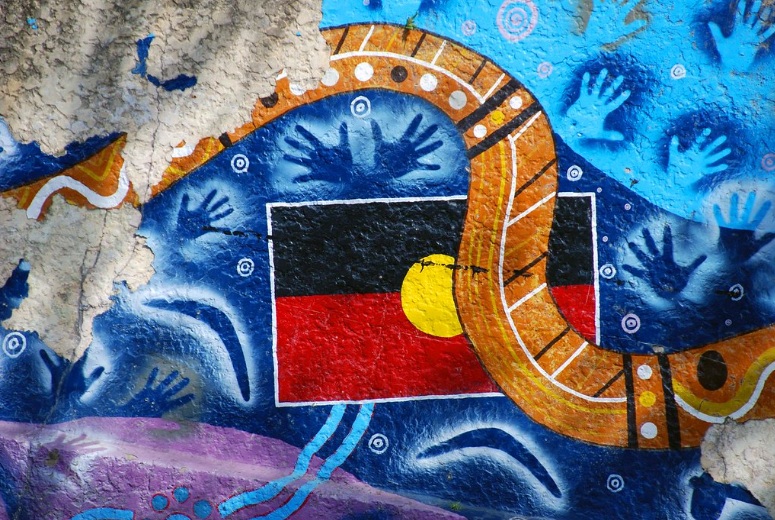
While they are visually beautiful, Indigenous artworks are so much more. Each mark, pattern, or symbol is no less significant than the preceding one. They typically tell sub-stories, share knowledge, or build bridges, drawing on wisdom that has been passed down for generations. To treat Indigenous artworks with respect and care, it is valuable to identify the symbols they entail.
1. Connection to Country
The most fundamental aspect of indigenous art is probably the connection to the land that they come from. Rather than representing general landscapes, land, water, and pathway icons are tangible representations of a strong connection to specific territories.
These kinds of signs are about ownership and responsibilities to the land. People are able to see not only the territory but also their relationship to these locations.
2. Storytelling Through Visual Language
Instead of being used solely for their aesthetic value, indigenous works of art are frequently utilised as tools for the purpose of communicating narratives. Stories about creation and the journey of the ancestors are told in indigenous art, along with important cultural information.
Instead of being told in a single, cohesive narrative, the stories are typically told in layers and through signs. In this way, the stories don’t ask you to come up with a clear interpretation; instead, they ask you to think about them and listen to them.
3. Use of Repeating Patterns
It is well known that indigenous art is characterised by the presence of numerous repeating patterns that are highly symbolic. Movement, travel, the cyclical nature of life, and a great deal of other things are all examples of things that it can represent.
It is more important to note that repetition is not merely decorative; rather, it is a symbol of continuity or connectedness. Instead of existing in a static state, this demonstrates how the culture, knowledge, and traditions are passed down from one generation to the next.
4. Layers of Meaning and Cultural Knowledge
Aboriginal Art often functions on more than one level. Despite the fact that a pattern or symbol may be easily accessible to the general public, certain meanings are only known to those who are part of a particular community or are insiders.
This may give the impression of being a barrier; however, it can also be interpreted as an invitation. It is possible to engage with cultural knowledge rather than simplify it if this is done in a manner that is both respectful and knowledgeable.
5. Symbolic Use of Colour
Indigenous artwork makes use of colour to communicate nuances and interpretations of the subject matter. The colour palettes that have been carefully selected range from the most earthy tones to the most earthy colours.
For the purpose of providing context for the significance of other components or narratives, the aesthetics of stronger contrasts contribute. Additionally, if you pay attention to the colours that are used in the work, you can choose them to represent the season, the location, or the spiritual significance of the work.
6. Representation of Community and Kinship
Symbolic shapes and arrangements express community and kinship. Circles, lines, and connecting forms might express meeting places, family groups, and shared journeys. These symbols highlight that indigenous culture is a collective identity. They manifest relatedness, distinctive roles, and mutual bonds, rather than autonomy.
Where Understanding Creates Deeper Respect
These are not pieces meant to be looked at quickly. Every symbol is recommending you take a moment, consider what has happened, and respect the centuries of culture that sit behind the work. As you appreciate them more, you can only develop your respect for the narrative.