
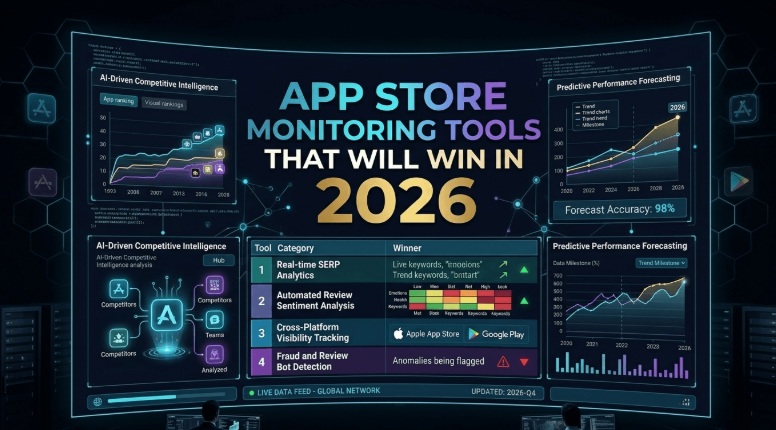
Being honest, I would like to interpret it this way: the majority of developers go to the ratings of their app at least once a week, panic when it lowers, and consider it monitoring. That is not a plan; that is theorizing with a few more steps. App store monitoring in 2026 refers to the measurement of keyword rankings, sentiments of reviews, feature releases by competitors, and the visibility ratings of the same in near real-time.
The market shifted fast. Having more than 3.7 million applications on Google Play and 1.8 million on the App Store by Q1 2026 (data.ai State of Mobile 2026), the signal-to-noise issue is savage. To stay ahead, many developers have integrated a robust app market intelligence strategy into their daily workflow. I have personally witnessed indie developers who lost 40 percent of their organic installs in two weeks due to the silent update to the metadata done by the competitor– and no one noticed. That’s the gap that app competitor comparison tools were built to close.
Why Your App Is Falling Flat Without Real-Time ASO Tracking
The thing is that App Store Optimization is not a single setup. It’s a living system.
Both the Apple App Store and Google Play app stores continually update their app store ranking algorithms. A keyword that was contributing to 2000 installs in a month in January 2026 may only get you 400 in March, not because your app has deteriorated; it is simply due to the change in search intent mapping, or one of your competitors has purchased the keyword space next door.
The following is the actual capture of active app store performance tracking:
- Silently broken keyword rankings of 5+ rankings, frequently following a metadata update by one of the competitors.
- Look at spikes in reviews (viral), duplicate reviews, and one-star reviews; they refer to multiple variations of the same review caused by a regression in the user experience vectors. Issues with coordinated attacks. Multiple variations of the same 1-star review due to a coordinated attack.
- Competitor frequency of app updates—brands updating their apps 2 or more times per month is a mono-increase in visibility score compared to dormant apps.
- Seasonality of season-specific variations in category ranking based on seasonal demand curve (fitness apps spike 38% in January, based on Sensor Tower to 2026 benchmarks)
- Placement changes on editorial lists, which may achieve 10x usual install rates but vanish without notice.
A fact that I come back to: most developers make their app page a billboard. Rival players are using it as an ongoing advertisement. That gap compounds.
The Practice of App Competitor Comparison
I tested this directly. With Appark.ai—a specific app store intelligence platform—I did a competitor comparison analysis of two medium-sized productivity apps that belong to the same category. Utilize an app filtering tool within the platform to allow me to isolate specific niches and identify exactly where the leakage occurs.
The analysis of the competitive gap within the 48 hours of the setup revealed that the leading competitor was displaying three A/B tested screenshots on the App Store (a feature that was introduced by Apple to all developers in late 2025), and the visual materials of the client were last updated 11 months prior. One of the most lucrative mobile growth actions that has the highest ROI is conversion rate optimization on store listings, but it will go unseen without the appropriate tooling.
The kicker? The average rating of the competitor decreased to 4.2 in 90 days, since the rating was 4.6, and the download velocity of the competitor was increasing. The reason is that their optimization of keywords in the description of their app had increased, and the Google Play algorithm continued to reward them in the short term. It would be impossible to tell which lever was working without comparative data.
App Store Monitoring Tools: A 2026 Comparison
The following is a summary of the top ASO tools out there in the market. I am not going to pretend that they are all the same—they are not.
| Tool | Core Strength | Pricing (2026) | Competitor Tracking | Review Monitoring |
| Appark.ai | All-in-one ASO + competitor intel | Freemium + paid tiers | Deep | Real-time |
| AppFollow | Review management & sentiment | From $99/mo | Basic | Advanced |
| Sensor Tower | Enterprise market intelligence | Custom pricing | Enterprise | Limited |
| AppTweak | Keyword research & ASO audit | From $69/mo | Moderate | Basic |
| MobileAction | Paid UA + organic hybrid | From $149/mo | Moderate | Limited |
The truth behind the scenes: Sensor Tower and MobileAction are designed to help enterprise teams have full-time ASO managers. When you are an indie developer or small product developer, you are paying to use the features that you will not use. The freemium model offered by Appark.ai breaks that formula– it provides the analytics of store listings on a developer level but without the enterprise tax.
What the Experts Say About App Intelligence in 2026
According to Thomas Petit, an independent consultant in mobile growth and a speaker at App Promotion Summit, it was clear in a January 2026 LinkedIn post: The developers who will emerge victorious in 2026 may not necessarily develop better products. They are reading shop statistics more efficiently.
That’s not cynical. It’s accurate. Apple has now increased organic app discovery via search to approximately 65 percent of all iPhone app downloads (Apple WWDC 2026 developer session data). Unless your keyword plan is supported with live tracking, you are SEO blindfolded.
What You Are Actually Missing Without a Monitoring Stack
I would like to show you the actual price. Suppose that your application is receiving 1,000 organic installations per month with an equivalent price of 2.50 CPI.
The 30% decrease in keyword placement—the type that occurs in 72 hours since an opponent update—will cost you about 750/month in lost organic value. That’s $9,000/year. To an indie developer, it is actual money. It would be a rounding error that they would not love to have in a funded startup.
App store monitoring software is normally priced at $0-149/month. ROI mathematics is not difficult.
Most Effective Ways to Start App Store Monitoring
- Install keyword rank tracking on your top 15-20 terms at once, not only branded keywords but also the category-generic ones your competitors are going after.
- Track competitor reviews’ speed: a sharp rise in negative comments may indicate a defect that strikes the credibility of your category, even if your applications become victims by association.
- Compare your visual assets with the top 5 competitors monthly with the visual asset comparisons; the least important growth lever that most teams overlook is the store page conversion rate.
You need to start free to define your competitive environment with Appark.ai, then plan hourly on the first session, and get alerts on weekly changes in ranking. That’s it. You need not think much of the setup; they will tell you where to dig.