
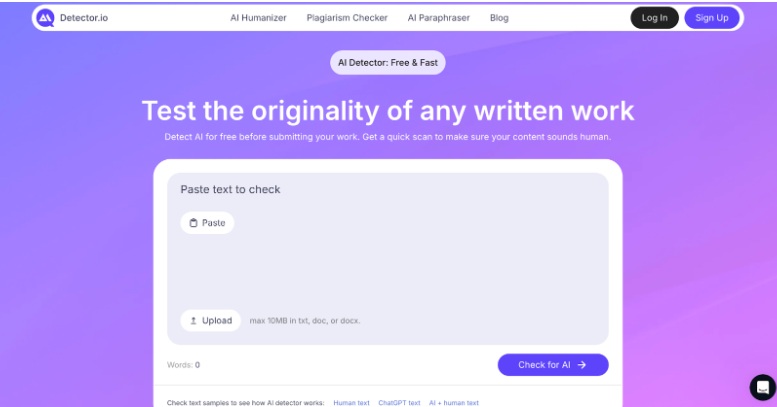
The rapid evolution of generative artificial intelligence has fundamentally changed how we produce content. From academic essays to marketing copy, the line between human and machine authorship is blurring. This shift has created a pressing market need: the ability to distinguish authentic human thought from algorithmic output. Amidst a sea of paid subscriptions and limited trials, Detector.io has emerged as a distinct player. It positions itself as an accessible, barrier-free solution for those who need to verify the originality of their work.
This review provides a comprehensive look at Detector.io, analyzing its interface, limitations, and underlying technology. Unlike many competitors that hide behind paywalls, this platform offers a generous usage model that appeals to students, freelancers, and educators alike. We will explore how it handles large documents, its accuracy methodology, and whether it truly stands up to the demands of modern content verification.
AI Detector Online: How the Technology Works
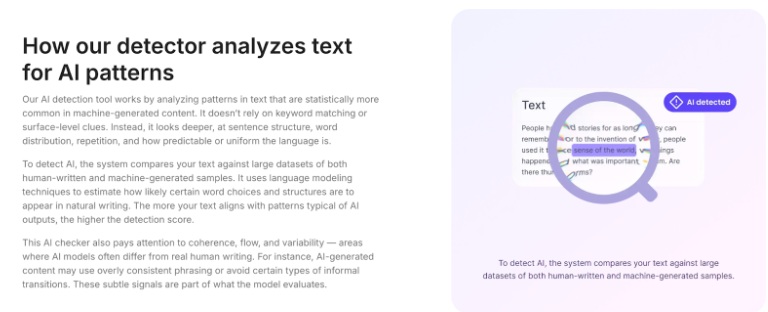
Detector.io operates by analyzing the statistical characteristics of a text. It does not “know” facts; rather, it understands the probability of word sequences. Generative AI models, such as ChatGPT or Claude, often produce text that follows highly predictable patterns, a concept known as low perplexity. Human writing, by contrast, is messier, more chaotic, and filled with “burstiness,” or sudden variances in sentence structure and vocabulary.
Detector.io’s engine scans for these specific markers. It looks at word distribution, repetition, and the uniformity of language. If a paragraph flows too smoothly, with transitions that feel mathematically perfect but creatively sterile, the tool flags it. Users looking to detect AI text will find that the tool highlights these suspicious sections, providing a visual map of where the content may need human intervention. This heatmap approach is far more useful than a simple percentage score, as it allows the writer to pinpoint exactly which sentences are triggering the alarm.
The platform is built on precision-based models that are finely tuned to recognize the signatures of major Large Language Models (LLMs). It processes data quickly, typically returning a result in moments, which is crucial for users managing high volumes of content. However, it is important to note that currently, the tool focuses exclusively on the English language to maintain high accuracy standards.
College AI Detector: Why Students Need It
Academic integrity is perhaps the most significant battleground for AI detection. For students, the risk of accidental plagiarism or false accusations of AI use is a source of constant anxiety. A reliable AI detector serves as a safety net. It allows students to pre-screen their essays and research papers before submission, ensuring that their original ideas are not mistaken for AI writing.
One of the standout features of Detector.io for the academic market is its capacity. While many free tools cap users at a few hundred words, Detector.io allows for scans of up to 3,000 words at a time. This is sufficient for most standard college essays, term papers, and case studies. For longer dissertations, students can simply split the document into sections. This high word limit removes the frustration of having to check a paper paragraph by paragraph, streamlining the editing process during stressful finals weeks.
Moreover, the tool is designed to be anonymous. It does not require users to create an account or log in. This is a critical privacy feature for students who may be wary of uploading their intellectual property to a database that requires personal identification. The ability to AI detect anomalies without a digital paper trail is a significant advantage for privacy-conscious users.
Free AI Detector Tool: Features and Limits

The marketplace for detection software is often segmented into expensive enterprise solutions and limited free versions. Detector.io creates a niche as a robust free AI detector tool that does not artificially throttle its utility. There are no hidden credits, no daily limits on how many times you can use the service, and no paywall for the “advanced” results.
Core Features at a Glance
- No Sign-Up Required: Immediate access to the scanning engine without email registration.
- 3,000-Word Limit: A generous per-scan cap that exceeds most free competitors.
- Highlighting System: Specific sentences are marked to show exactly what looks robotic.
- Integrated Ecosystem: Quick links to an AI Humanizer, Plagiarism Checker, and Paraphraser.
However, “free” does come with functional boundaries. The most notable is the language restriction. As of 2025, the tool supports English only. This limits its utility for international students or global businesses operating in multiple languages. Additionally, while it is a powerful tool to detect AI writing, no detector is infallible. False positives (marking human text as AI) and false negatives (missing AI text) are inherent risks in this technology. Detector.io mitigates this by focusing on pattern recognition rather than simple keyword matching, but users should always use their judgment in interpreting the results.
Below is a breakdown of how Detector.io stacks up against typical market expectations for free tools:
| Feature | Detector.io | Typical Free Competitor |
| Cost | $0 (Free) | Freemium (Paid upgrades) |
| Word Limit/Scan | 3,000 Words | 500 – 1,000 Words |
| Registration | None | Often Required |
| Analysis Type | Deep Pattern/Highlighting | Simple % Score |
| Language Support | English Only | Multi-language (often poor) |
AI Detector for Writing: Beyond Academic Use
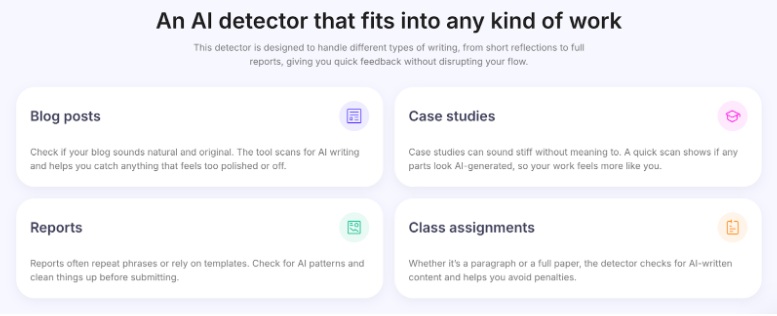
While the academic sector drives much of the demand, Detector.io is equally valuable for professional content creators. Bloggers, copywriters, and SEO specialists use the platform to analyze their drafts to ensure their content retains a human voice. In the world of search engine optimization, content that reads as “human” often performs better in rankings and user engagement. Search engines prioritize helpful, people-first content, and generic AI output can sometimes be penalized if it adds no value.
The tool helps writers refine their tone. If a section is flagged, it often indicates that the writing is flat, repetitive, or overly formal, traits common to both AI and uninspired human writing. By revising these sections, writers not only bypass detection but often improve the readability and engagement of their work.
Furthermore, the platform acknowledges that detection is only half the battle. If a user finds their content is flagged, Detector.io offers pathways to fix it. The site includes an AI Humanizer and a Paraphrasing tool. These utilities help users rewrite “robotic” sections into more natural prose. For professional editors, the tool can also serve as an AI detector for teachers or content managers who need to verify freelance submissions. Knowing whether a submitted article was written by the hired expert or generated by a bot is crucial for maintaining quality control in publishing.
Real-World Use Cases
- Content Marketing: Verifying that blog posts have a unique brand voice before publishing.
- Recruitment: Checking cover letters to see if applicants are using generic AI templates.
- Creative Writing: Ensuring that stories and narratives maintain emotional depth and structural variance.
- Technical Documentation: Balancing technical accuracy with human-readable explanations.
The Role of Support and Accuracy
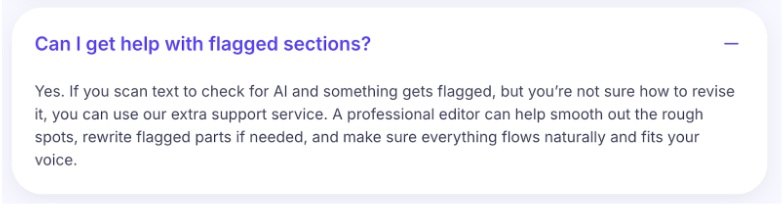
One unique aspect of Detector.io is its approach to user support. Unlike many anonymous tools, it provides a support email (support@detector.io) and mentions the option of professional assistance. If a user is struggling to get their text to pass or feels the result is inaccurate, the platform suggests that professional editing services are available to help smooth out the “rough spots.” This human-in-the-loop option is rare and adds a layer of reliability for users dealing with high-stakes documents.
The accuracy of the tool is rooted in its training on large datasets of both human and machine-generated text. By constantly comparing new input against these baselines, it remains effective even as AI models update. However, users must remember that the goal is to detect AI text patterns, not to prove authorship beyond a reasonable doubt. It is a diagnostic tool, not a legal one.
Conclusion
Detector.io stands out as a high-value utility in the AI detection landscape. Its combination of a high word count limit, cost-free access, and deep analytical highlighting makes it a top choice for anyone needing to verify the authenticity of English text. Whether you are a student protecting your GPA or a content manager protecting your brand voice, it offers a frictionless, reliable way to ensure the human element remains front and center.