
Sports attention now moves in layers, not blocks. Nielsen’s January 2026 Media Distributor Gauge showed TV viewing at a 12-month high, with YouTube at 12.5% of all television use, Disney at 11.9%, and ESPN up 82% month to month on the back of the College Football Playoff and championship games. A fan can watch Indiana beat Miami 27-21 in the College Football Playoff National Championship at Hard Rock Stadium on January 19, 2026, check a live table, then open a team app before halftime is over. That pattern is the story.
Live rights changed the clock
Netflix’s NFL Christmas package made the shift plain. The two games on December 25, 2024, averaged 26.5 million U.S. viewers and reached an unduplicated U.S. audience of nearly 65 million, and a year later, Netflix said its 2025 NFL Christmas Gameday generated more than 632 million global owned social impressions. The routine changed. A national game is no longer only a broadcast window; it is a stream, a social event, and a prompt for clips, reaction posts, and second-screen checking while the score is still live.
The app became the arena
The NBA has leaned into that change harder than most leagues. Its 11-year media deals with Disney, NBCUniversal, and Amazon began with the 2025-26 season, and the league said the NBA App would serve as a universal access point directing fans to every national game across those platforms; the same announcement raised broadcast exposure to about 75 regular-season games per season, up from a minimum of 15 under the previous agreement. Then, on October 13, 2025, the league launched a new streaming offer inside the NBA App and a reworked NBA TV, with 60 regular-season games on NBA TV beginning October 25 when Oklahoma City visited Atlanta.
Quiet actions now get counted
Fantasy products have changed how people watch the sport itself. Premier League Fantasy added defensive contributions for 2025-26, so a defender who reaches 10 clearances, blocks, interceptions, and tackles in one match earns two points, while midfielders and forwards need 12 because recoveries count for them too. The small observations are the point: James Tarkowski hit his seventh, eighth, and ninth actions against Manchester City in a few seconds with a tackle, a clearance, and a block, and Moisés Caicedo’s tally against Arsenal included the moment he tackled Declan Rice and released Nicolas Jackson into a 1v1. Fans are no longer waiting for a goal to feel involved.
Mobile moved from an add-on to a habit
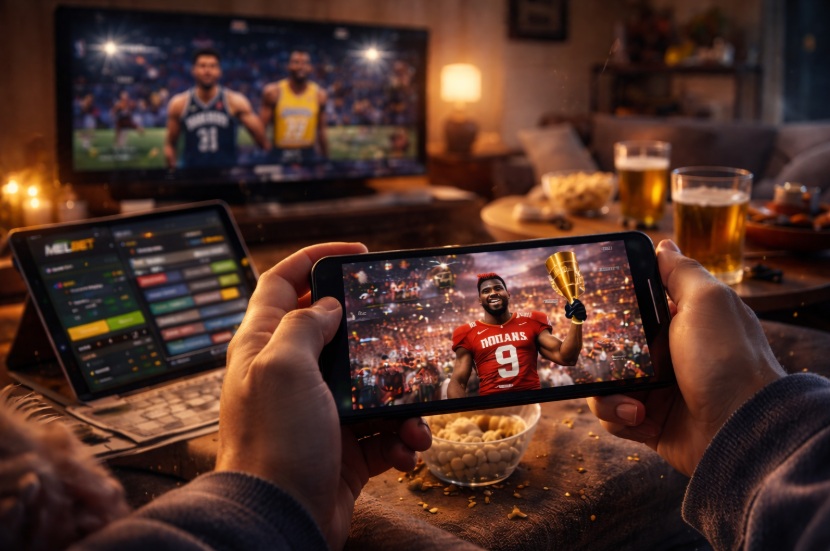
Mobile services have become part of the same matchday rhythm. A fan following a Saturday slate or a late Champions League kick-off may download Melbet (Arabic: تحميل ميل بيت) not as a separate ritual but as another layer of the screen already in hand, with pre-match lines, live markets, and built-in statistics sitting next to the stream and the chat. MelBet’s own materials describe thousands of live and pre-match events, advanced statistics, access across iOS, Android, web, and mobile web, plus live streaming and in-play betting; the same materials also claim more than 9 million downloads per month and 30,000-plus daily events. The phone stayed central.
Choice became part of the draw
Platform design now shapes how people watch, not just where. NBA League Pass currently offers home and away broadcasts, a Mobile View optimized for phones, alternate camera angles such as sideline cam and backboard cam, Multiview for up to four games at once, and in-game overlays with player stats, scores from other games, and live odds; Premium users can also download full games, recaps, and condensed games to Android and iOS devices. There is still friction in the system, which matters: nationally televised games do not appear live on League Pass in the United States and become available at 6 a.m. ET the next day, so product design is now part of the fan’s schedule planning in the same way tip-off time used to be.
The feed never really ends
The end point is not a bigger audience in the old sense; it is a denser one. The NBA says its digital and social ecosystem now reaches more than 2.3 billion likes and followers globally across league, team, and player platforms, while the app itself is positioned as a 24/7, 365-day basketball hub with live games, highlights, original shows, and coverage that stretches from the WNBA and G League to the Basketball Africa League and top high school events. That keeps engagement from collapsing when the final whistle goes, because the match report, the clip, the fantasy recalculation, and the next stream are already waiting in the same place.