
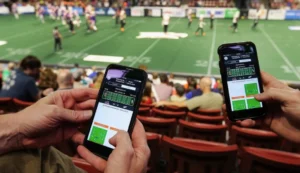
Sports betting has never been so easy to access. In total, there are now legal sportsbooks in 38 U.S. states. Most of these have highly developed mobile applications, very large welcome bonuses and an incredibly wide variety of bets can be made on most nights. For many of those who are new to wagering at least one thing has not kept pace with this increased availability: a basic understanding of how all of it works.
This article addresses that need. It will explain everything without assuming prior knowledge or using language which may mean something else to someone outside of the industry. It also does not skip over the fundamentals just because some may find them to be obvious. If you’re completely new to placing sports bets and would like to get the full view before making your first wager, begin with this article.
Is Sports Betting Legal Where You Are?
First, find out what’s happening with sports betting in your home state. In 2026, 38 states and Washington DC will allow adult sports betting. The other states – Texas, California, and Georgia (which has pending legislation), among others – do not yet have an operational sportsbook.
Regardless of where you live, placing a bet using a licensed app requires that you are physically inside a legal state when you place the bet. Geolocation technology embedded in each of the licensed apps will automatically enforce this condition.
If you live in a state with no legal sports betting, sweepstakes sportsbooks provide a legal alternative – they utilize the promotional sweepstakes model to allow people to play sports-prediction type games without needing a gaming license. While they’re not the same as a licensed sportsbook, they are still a viable option until your home state passes a law allowing you to access one legally.
So, assuming you reside in a legal state: Here is how you can start to participate in sports betting!
Understanding Betting Odds: The Foundation of Everything
Odds are the way most people talk about their sports bets. Whether you’re talking about a game winner, or a 12 leg parlay, every bet is going to be talked about by using odds. Learning what the odds are, and what they represent, is probably the first serious thing a person will learn when becoming a sports gambler.
In the United States, we use an odds system called American odds. It is also referred to as money line odds. These odds can come in several different formats; -110, +150, -230, +350 etc. When you take the sign and the number together, it tells you two things. First off, it tells you who the favorites are. Secondly, it tells you how much money you will need to place in order to get back $100 in profit based on your bet.
Negative odds (-110,-230) : A negative number represents the side that is considered to be the favorite. The larger the negative number, the more likely the favorite is to win. In addition, the number of dollars needed to bet to get back $100 in profit, is directly related to the size of the negative number. For example, if the negative number was -110, then you would need to bet $110 in order to win $100. Likewise, if the negative number was -230, then you would need to bet $230 in order to win $100.
Positive odds (+150,+350): A positive number indicates that the side being referenced is considered to be the underdog. Just like with negative numbers, the size of the positive number has a direct relationship to the amount of profit you can expect to receive per dollar invested. For example, if the positive number was +150, then for every dollar invested ($100), you could expect to receive $150 in profit. Similarly, if the positive number was +350, then for every dollar invested ($100), you could expect to receive $350 in profit.
As mentioned earlier, you do not necessarily need to invest exactly $100. The $100 figure is simply used as a reference point in order to express odds. For instance, if you decided to bet $50 instead of $100 at +150 odds, you would still collect $75 in profit. As stated above, this ratio will scale proportionately.
Another number you may continually see is -110. Many times you may see this posted along with the point spreads and total lines. This is commonly known as the juice or vig. The juice or vig is nothing but a fee that is collected by the bookmaker. If there were no vigorish and both sides of a particular bet were equal (or true 50/50 chances), then the odds would be +100 on each side. However, since there is vigorish (-110), there is always a slight advantage for one side of the bet over another.
The Main Types of Sports Bets
There are six types of bets that will be common with most everyday players. When you understand these six, you have the entire package.
1. Moneyline
This is the most basic form of wagering in sports. It simply allows you to choose which team you think will win the game, without concern about a “point spread” or other conditions. Odds reflect the likelihood of either side winning.
Example: Lakers -180 vs. Celtics +155 (Bet $180 to get $100, or Bet $100 to get $155). The Lakers are the favorite and the Celtics are the underdogs.
2. Point Spread
This is the most commonly used bet type in football and basketball. This bet style focuses on the margin of victory as opposed to just choosing who wins. The Sports Book establishes a “spread”, for example, Chiefs -6.5. To cash your bet on the Chiefs, they must win by 7+ points. If you place a bet on the opposing team (+6.5), then you win if you bet on the opposing team when they either win the game straight up or lose by 6 or less than 6 points.
3. Over / Under
You can place a bet on how many points both teams have scored combined. The bookmaker has set the line – say, 47.5 in a football game – and you bet either that the total number of points the two teams combine to produce is OVER this number, or UNDER this number. Both sides of the market usually get the same price -110.
The totals market is popular because it gives you something to root for regardless of which side you think is going to win.
4. Parlay
A parlay is when you put two or more individual wagers together to create one wager. In order for your parlay to result in a payment, all of the wagers included in the parlay must win. Because there is no way to lose money with the parlay, there is a big incentive to make multiple wagers. However, since you need all of the wagers to win for you to receive a payout from a parlay, the potential payoff is much larger than what you could get if you had made just one wager.
Parlays can be entertaining and sometimes lead to large payouts. On the other hand, from a mathematical standpoint, parlays are some of the poorest value bets available through a sportsbook. A sportsbook takes advantage of their margin every time a new wager is added to a parlay. Therefore, parlays should be viewed as entertainment rather than part of your betting strategy.
5. Props (Proposition Bets)
Props are wagers on specific games aspects instead of a game result. The most popular type of prop is player props. Player props allow you to place a bet on an individual performance metric; i.e., how many passing yards a quarterback has thrown, how many assists a basketball player had, how many strikeouts a baseball pitcher had, how many aces a tennis player served. Game props include things such as, what team will score first and/or if a game will go into overtime.
The growth rate of prop betting is among the fastest growing of all sports betting categories. Props create a rooting interest for each side involved, regardless of the potential difference in scoring at any point during the game. Additionally, researching props requires a distinct approach from game line and moneyline research.
Bet Types at a Glance
| Bet Type | What You’re Betting On | Typical Pricing | Best For |
| Moneyline | Who wins outright | Varies by matchup | Simple, clear outcomes |
| Point Spread | Margin of victory | -110 each side | Football, basketball |
| Total (O/U) | Combined score | -110 each side | Any sport |
| Parlay | Multiple legs combined | Compound odds | Entertainment / big payouts |
| Player Prop | Individual stat outcome | Varies | Engaged, research-driven bettors |
| Futures | Season-long outcome | Long odds | Early-season value plays |
How to Place Your First Bet: Step by Step
Moving from zero to being ready to make a wager is easy using any large licensed sportsbook. Each of FanDuel, DraftKings, BetMGM, Caesars, and most all of the other big-time bookmakers have similar processes:
- Install one of the apps for a licensed sportsbook that operates in your state. Make sure it’s the actual app from the App Store or google play – do not install through third party links.
- You’ll need to input your name, address, date of birth and the last 4 numbers of your Social Security #. That is part of the normal KYC (know your customer) verification that is required by state regulators – it is not discretionary.
- Turn on location services. The app will ask to verify you are physically located inside the legal state. This is also mandatory. If you refuse they will not allow you to put bets.
- Take advantage of your welcome promotion. Many new user offers can be activated during registration – deposit matches, bonus bets, no sweat first bets. Take a minute to read the terms before making a deposit as each has their own wagering requirement and conditions.
- Fund your account. Most sports books support Visa, Mastercard, PayPal, online bank transfers, and Venmo. A few use apple pay and google pay. Most funds into your account instantly.
- Locate your bet. Go to the sport & game you want to bet on. Tap on the odds for the event you wish to bet on – this selection will show up in your bet slip.
- Input your stake and confirm. Enter how much money you want to bet on in your bet slip. The app will display what you can win if successful. View, review, confirm and the bet will be placed.
That’s it. As mentioned earlier – while the basic mechanics of placing wagers are really quite easy – finding which wagers provide best value takes practice & development.
Shopping for the Best Odds: Why It Matters
One thing separating sharp bettors from casual bettors is line shopping, (comparing odds for the exact same bet, across multiple sports books) and betting with the book with the best number.
Although a difference of -110 to -105 on a single play may seem negligible, over many plays it could be the difference between winning and losing as a player. Maintaining an account with 2-3 separate, state licensed sports books and taking the time to check which sports book has the most favorable odds prior to placing your wagers will create one of the most valuable skills/ habits you will develop as a bettor.
Now days, odds comparisons are available through the majority of the main-line sports books in the form of apps and/or web-sites; in addition, there are also numerous 3rd party odds comparison tools that compile odds from all legally operating sports books within your state in real-time.
The Bottom Line
Sports betting has never been more available than it is today.
In 2026, sports betting will be more fun, more easily accessible and more legal for consumers than at any other time in history. The apps are very good; the variety of markets to bet on is outstanding; and the barriers to entry are lower than they have ever been. So what separates a person who can successfully use his money to make bets, versus one who cannot? Luck doesn’t separate them – it’s learning how all of this works (i.e. the math), developing some reasonable expectations about success and making smart decisions based upon a disciplined bankroll management.