
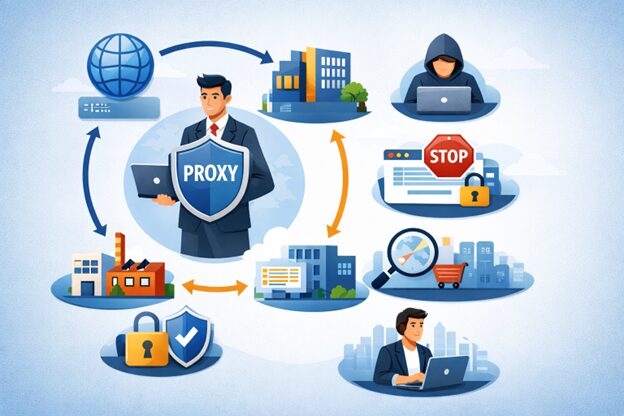
A large number of local companies use a complex instrument to track the indicators of the market. If you start researching modern infrastructure, you might ask what is the proxy? This technology is an intermediary between your computer and the rest of the web. It channels your request that is going out. It is a scaling process that enables you to scale within platform constraints. A market analysis of the global market of these servers shows that the market has reached 5.75 billion this year (Source). This growth is an indication of a 15 percent growth per year since 2025. These tools are used by businesses to process close to 120 zettabytes of information worldwide.
Establishing a Clear Proxy Server Definition
So what is proxy service? Its knowledge assists local companies in handling complicated data collection. These platforms offer the technical layer required in work profile management. They make sure that your office connection can communicate with the world sites effectively. These solutions are being applied by numerous companies in their digital expansion. They are usually used together with international SEO strategies to access a broader audience.
The proxy captures your request when it is sent by your device. It then forwards that command to the destination site. The site replies to the intermediary, and this ultimately provides the records to you.
Is this like a virtual private network? While they share traits, the proxy vs VPN debate highlights key functional differences.
- A proxy typically works at the application level. It manages traffic of a particular browser or software application.
- A VPN normally encompasses the whole device connection.
What Are the Common Types of Proxy Servers?
Contemporary providers provide various types of routing identifiers. The selection of the appropriate one is based on your work profile management objectives. We can break down the various types into three primary groups.
Datacenter Proxies
These are large server hubs. They come from high-speed facilities and offer the fastest response times.
Residential Proxies
These come from legitimate home internet service providers. They use a real home address and appear as standard user traffic to target websites. This great degree of authenticity makes them suitable for sensitive tasks, and specialized providers such as Proxy-Seller can offer you credible solutions to such tasks.
Mobile Proxies
The latest type is based on cellular networks such as 4G and 5G. These mobile proxies route your usage through mobile carrier towers. They are also good at testing the appearance of content on smartphones.
What Is the Proxy Technical Part?
Most web users rely on an HTTP and HTTPS proxy for standard browsing. These formats deal with the text and media files on the standard websites. They are suitable for simple market research and price monitoring of the people.
However, what happens when you have to work with more than web pages? A SOCKS5 proxy provides a more flexible solution. It is capable of dealing with any form of transmission, such as an email protocol or file transfer. It is at a lower level of the network stack. This enables it to circumvent some technical filters that could prevent normal web-based use.
| Protocol Type | Best Use Case | Key Strength |
| HTTP | Basic web scraping | High compatibility |
| HTTPS | Encrypted transfers | Safe connections |
| SOCKS5 | Non-web applications | Versatile formats |
What Is the Proxy Cost in 2026?
The cost of this service depends on the technology behind it and the amount of use. Local companies should plan their finances to prevent any surprises. The majority of providers charge on a per-IP flat rate or a per-gigabyte consumption model.
- Datacenter: You typically pay a monthly address fee. Expect to spend $0.50 to $1.50 per unit.
- Residential: These businesses tend to charge per gigabyte used. The existing market rates are between 3.50 and 7.00 per gigabyte.
- Mobile: Cellular plans are the most expensive and may range between $5.00 and $12.00 per gigabyte depending on the area.
Custom rates are usually negotiated in large-scale operations. When your business is processing multiple terabytes of data each month, you may frequently get a 20-30 percent discount. Always verify bulk pricing levels before signing a long-term contract.
What Are the Pros and Cons?
There is no technical tool that fits all situations. You have to consider the advantages and the possible disadvantages.
Pros:
- Scales to a huge degree of web scraping.
- Facilitates local testing of international marketing campaigns.
- Helps isolate various work profiles of social media management.
Cons:
- Makes your network configuration more complicated.
- Residential volume of high quality is very costly.
- There are providers that provide low speeds on shared pools.
Practical Advantages of IP Address Masking
The primary technical benefit of these applications is IP address masking. This procedure replaces your local computer identifier. It assists your team to gather information in public without disclosing the source of the request. Why is this important to a local company in Iredell County?
Suppose you have to check competitor prices in the state. When you make 5,000 calls using a single computer in the office, the target site may slow down your connection. By routing such calls via several endpoints, the process proceeds without any problems. It keeps your collection activities effective and continuous.
How to Get Started
Adhere to a systematic method. Do not purchase a huge package at once. Begin with a small test to ensure that the setup is correct for your task.
- To begin with, determine the websites you have to visit. There are sites that are quite strict and demand a high-end residential address. Others permit easier datacenter connections.
- Second, select a provider with a trial period. The majority of reputable companies will give you the opportunity to test 100 MB of traffic at a few dollars.
- Third, keep track of your success rates. In case your request is often unsuccessful, you might require another kind of pool.
The process of scaling your infrastructure must be gradual. We would recommend that you begin with one work profile and then transition your whole team to a new arrangement. This cautious strategy will avoid downtime and save your budget.
Summary
You now understand what is the proxy and how it supports modern enterprise tasks. These solutions, from routing protocol formats to pricing structures, provide a lot of utility to data-driven companies.