
I’ve seen people accept job offers based on the gross number. Big mistake. That “$75,000 salary” lands in your bank account as something much smaller—and the problem most people overlook is FICA tax. Most financial conversations skip right past it. They talk about federal income tax brackets, standard deductions, and adjusted gross income. But FICA? It’s quiet and automatic, and it hits before you see a single dollar. Here’s the thing: once you understand how payroll deductions actually work, you’ll never look at a job offer the same way. I’ll show you how to get your real number in minutes.
What Is FICA Tax—And Why Should You Care?
FICA stands for the Federal Insurance Contributions Act. It covers two massive U.S. programs: Social Security and Medicare. You don’t file it separately. You don’t choose it. It comes straight out of every paycheck before you touch it.
In 2026, here’s what you pay:
- Social Security tax: 6.2% on wages up to $180,000 according to 2026.
- Medicare tax: 1.45% on all wages—no cap
- Additional Medicare tax: 0.9% on wages above $200,000
Your employer matches the 6.2% Social Security and 1.45% Medicare portions dollar for dollar. That’s the part most employees never see. If you’re self-employed, you pay both sides—15.3% total—through the self-employment tax. That’s a brutal reality for freelancers doing their first salary estimate.
How Much of Your Paycheck Does FICA Really Take?
Real-world example.
Mini Case Study—Jane, a registered nurse in Texas:
Jane earns $72k per year. She gets paid bi-weekly, so her gross pay per check is $2,769.23.
Here’s what gets deducted before she sees a cent:
- Social Security (6.2%): $171.69
- Medicare (1.45%): $40.15
- Federal income tax (estimated at 22% bracket): ~$345
- Health insurance premiums (pre-tax): $85
Her net pay is around $2,127 per check—or roughly $55,302 per year. She thought that she earned $72,000. Her real take-home income is 23% lower.
This gap is what most salary calculators ignore.
2026 FICA Tax Rates vs. Federal Income Tax: A Quick Comparison
| Tax Type | Rate | Applies To | Employee Pays | Cap |
| Social Security | 6.2% | Wages | Yes | $180,000 (2026 wage base) |
| Medicare | 1.45% | All wages | Yes | None |
| Additional Medicare | 0.9% | Wages over $200K | Yes | None |
| Federal Income Tax | 10%–37% | Taxable income | Yes | None |
| State Income Tax | Varies | Varies | Yes (most states) | Varies |
Sources: IRS.gov (updated January 2026), Social Security Administration wage base announcement 2026
The Tools People Use to Estimate Their Salary (And Why Most Fall Short)
Most free paycheck calculators online give you a basic answer. They ask for your gross salary, pick a filing status, and spit out a number. Clean, fast, and often wrong.
They miss:
- Pre-tax deductions like 401(k) contributions, HSA contributions, and health insurance premiums—all of which reduce your taxable wages
- State income tax rates that vary wildly (California hits 13.3% at the top; Texas and Florida take zero)
- Local city taxes that some calculators ignore entirely
- The W-4 allowances you claimed when you started the job
The result? A salary estimate that looks good on a document but doesn’t match your actual paycheck stub.
“Workers consistently underestimate what they’ll take home. It’s not a math problem—it’s a missing information problem.” — SHRM (Society for Human Resource Management), 2026 Workforce Compensation Report
How Salary-Calculator.ai Gives You the Real Number
Salary-Calculator.AI is a financial planning tool built specifically for US households. It sums together federal income tax, FICA tax, state tax, and personal deductions to calculate your true net salary—not just a guess.
What I like about it: it doesn’t treat you like a tax professional. You enter your gross income, your filing status, and your state. It handles the rest. The output isn’t a lecture on tax brackets — it’s a clean salary estimate you can actually use for budget planning.
It’s especially useful if:
- You’re compare two job offers and need to see the real difference in take-home pay
- You’re a freelancer calculating your self-employment tax liability
- Your household has two incomes, and you want to see the combined effective tax rate
Best Ways to Actually Improve Your Take-Home Pay in 2026
Look, you can’t bypass FICA. It’s federal law. But you can reduce your taxable wages—and that’s where smart planning kicks in.
- Max your 401(k) contributions. In 2026, the IRS contribution limit is $23.5k for employees under 50. Every dollar you contribute reduces your federal income tax liability—though not your FICA base.
- Use a Health Savings Account (HSA). If you have a high-deductible health plan, contributions are triple tax-advantaged: pre-tax, grow tax-free, and withdraw tax-free for medical costs.
- Review your W-4. An outdated W-4 form means you’re either over-withholding (giving the IRS an interest-free loan) or under-withholding (facing a tax bill in April).
These aren’t hacks. They’re standard personal finance moves that millions of people skip because no one explains the connection between payroll deductions and final net pay.
What’s Your Real Number?
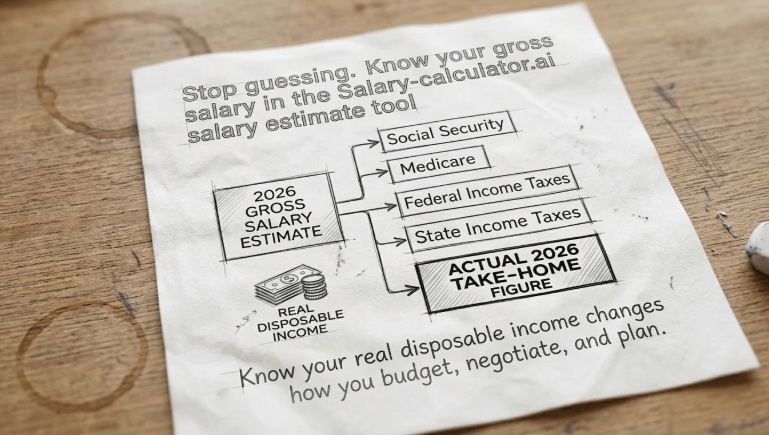
Stop guessing. Know your gross salary in the Salary-calculator.ai salary estimate tool and get your actual 2026 take-home figure—after Social Security, Medicare, federal taxes, and state taxes.
Know your real disposable income changes how you budget, negotiate, and plan.