

BY DEBBIE PAGE
Be Well Iredell’s “Forward Together” summit featured youth voices and powerful stories that sought to create connection, conversation, and action to reduce the stigma of mental health issues and educate attendees on how to help someone in crisis.
Program Coordinator Genevieve Glaser welcomed the audience of about 200 to the annual event. She thanked presenting sponsor Iredell Health System for its support.
Iredell Health System President & CEO John Green applauded the progress being made about speaking more openly about mental health issues. Before there was only silence and whispers because the subject was considered “taboo.”
“Bringing mental health out to the open is better for all of us,” he said.
Though Green has served in healthcare settings for decades, he said that only in recent years has the connection between physical, behavioral, and mental health been strongly considered when treating patients.
“Many research studies have shown that physical, mental, and behavioral health are intertwined. Healthcare providers are now looking at the whole mind and body when they evaluate health,” he said.
Green noted the purchase of Iredell Davis Behavioral Health in October of 2024 was a leap of faith for Iredell Health System. Though the acquisition of the facility was financially challenging, Green recognized the community’s need for mental health services.
He urged community members to work together to create better mental health for all because no one can do anything totally on their own. “We work better together,” he said.
Green thanked the several hundred gathered at the Statesville Event Center who took the time to come to the summit. He offered them one more challenge: to focus, learn, and participate in order to be fully engaged in making the community better for all.
What’s Your “True Color?”
Interactive session facilitator Cheryl Fuller was an educator and principal for decades but transitioned into mental health work after earning a master’s degrees in counseling and educational leadership. Her personal interests and experiences led her to acquire additional education and to earn certifications in Trauma Informed Practices, Social/Emotional Learning, and Professional Resilience.
Fuller said disruption of connection with others, of routine and structure, of familiarity of expectations, or of security and safety can create a trauma reaction. The COVID-19 pandemic was catastrophic because the whole world was traumatized by fear, grief over lost loved ones and friends, lack of human connection, and subsequent societal shutdowns.
“Everyone is still healing and reeling from the consequences of the pandemic,” she said.
Building healthy relationships provides the best cure, Fuller advised. Ironically, the way to heal trauma is to restore the same four factors: connection, routine and structure, familiar expectations, and safety and security.
Fuller led attendees through the True Colors inventory, developed by Don Lowry, to identify attendees’ personality style (by color) to increase personal understanding and understanding of others to decrease conflict.
Fuller discussed the traits of each of the four personality colors (yellow, blue, green, or orange) as well as the stressors to avoid for each color.
KEYNOTE SPEECH
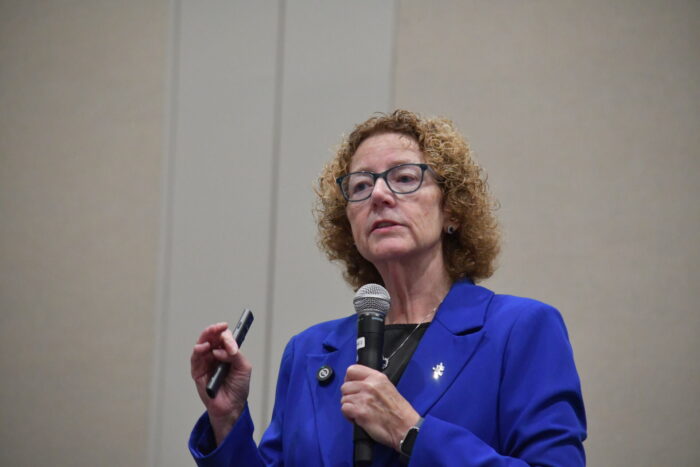
Fuller returned in the afternoon to deliver the keynote speech, beginning her presentation with the case study of a girl born into an abusive family. Her father brutally mistreated all four children, but her father hated her most as the only girl.
She suffered over a dozen broken bones, 100 stitches, and multiple surgeries as well as sexual abuse beginning at age 5 that ended with a pregnancy at age 11. The child was also forced into incidents of animal abuse and cruelty and was locked in a basement with no light or stimulation and only minimal food and water from ages 5 to 9, Fuller said.
After her parents divorced, her mother’s new husband forced her to choose only one of two children still at home to live with them. Her mother chose to take her younger brother, leaving the then 15-year-old girl homeless.
Fuller shared strategies for helping heal trauma like the girl’s, asserting that with trauma patients the most important thing is to listen, not to attempt to fix them or their situation.
The helper should understand whether the person is looking for support or for solutions and then proceed accordingly.
Those helping a person who has suffered trauma must be authentic. Being real and honest and admitting to not knowing an answer rather than faking it are also important.
Transparency about reporting requirements for teachers or healthcare professionals before helping trauma victims is essential so they do not feel betrayed if abuse is reported to law enforcement, child protective services, or other agencies.
Working with trauma survivors requires patience because building trust takes time. Consistency is also important. Honoring even the smallest request will show that they can count on the helper.
The helper must also be available when promised and monitor their own moods and attitudes for consistent behavior. Being able to depend and rely on someone is something trauma survivors may never have experienced.
To create a meaningful relationship with a trauma victim, the helper must listen more than they talk, be fully present, and make the person feel as though they care.
Working with trauma survivors also means that the helper may have to accept a lack of resolution to many situations because listening may be all they really desire.
Curiosity is also important because working with trauma patients offers an opportunity to learn from them and appreciate the strength they exhibited to survive. Recognizing and honoring their resiliency. with empathy, empowers the trauma survivors.
Providing opportunities for trauma victims to contribute to others in some way also fuels resiliency. Looking for their strengths and finding ways to share those strengths with others is healing.
Helping them to problem-solve and finding ways that their experiences can help others is also restorative. Involving them in fun activities also allows for short escapes from their difficult reality.
Honoring their priorities and decisions is also important. Helpers must create a space where the trauma survivor feels safe to make mistakes or to share them when they have been wrong.
Watching survivors make poor decisions is a difficult part of the healing process. The helper can relay that the decision is not the most beneficial one, but it is their life and they have to choose how to live it.
Avoiding “I told you so” responses is also important. When survivors make poor decisions, helpers should work to keep them be as safe as possible as they experience the consequences.
Fuller then discussed the effect of trauma on the brain, noting that the brain remembers both positive and negative experiences. When trauma occurs, the brain takes over the body and cannot learn information until the basic human needs for safety and survival are met.
“The brain goes back to its primary job to regulate the body and pulls back on the ability to learn. A person in trauma may experience physical reactions such as nausea or headache, and cognitive function starts to be affected.”
Fuller said trauma is recorded in the brain through all five senses, and the smells, sights, tastes, sensory experiences, and sounds experienced during trauma can trigger a traumatic reaction years later.
Fuller then asked attendees to eat a piece of lemon candy she left on the tables during lunch. She then told the story of the case study subject being tortured by her father with cuts on her hands until she could withstand them without crying. After thinking the abuse was over, she then watched her father cut a lemon and squeeze the juice into her raw, bleeding hands until she no longer cried. The smell of lemon still triggers that traumatic memory for her decades later.
Fuller then shocked the audience by revealing that the study was her own childhood experience.
She told the tearful audience that she overcame these horrors because of caring educators and healthcare workers. These meaningful relationships during the day helped her to survive her life at home and later on the streets.
Fuller has recounted the full story of her childhood trauma and resilience to go on to live a full life in her memoir “Peace By Piece.”
When she became homeless, Fuller slept under a bridge or at friends’ homes until she saved enough at 16 to buy a car to live in. When it was cold, she slept in the locker room at school, the door left ajar by a kind janitor who also provided food.
Fuller got random $100 support payments from her abusive father until she was 18. Her only comfort was a stray dog, Billie, that she took in. Billie made her feel loved and needed.
Over a school holiday, Fuller had no place to go in a bitter cold snap, and her only choice was to go to the new home her father was building or freeze to death. He told her she could stay for the week if she paid him most of her child support that month.
When Fuller left one evening for a babysitting job, her father took Billie to the animal shelter and told them to put the “dangerous” dog down after the dog chewed on a door frame. Fuller located the shelter in a nearby town but was too late to save her beloved dog.
Broken and lonely, Fuller returned to living in the locker room. She survived through high school with the food and clothing left by the janitor and earned straight A’s. School was a place of approval when she felt alone and insignificant during her homeless struggles, she said.
Fuller’s second memoir, “You Must Speak in the Light,” recounts her 20-year therapy journey to overcome her unthinkable childhood trauma to find recovery and a life of joy and peace.
She hopes her story and her path to resilience, hope, and happiness will inspire other trauma survivors on their healing journeys.
SPOTLIGHT SPEAKER
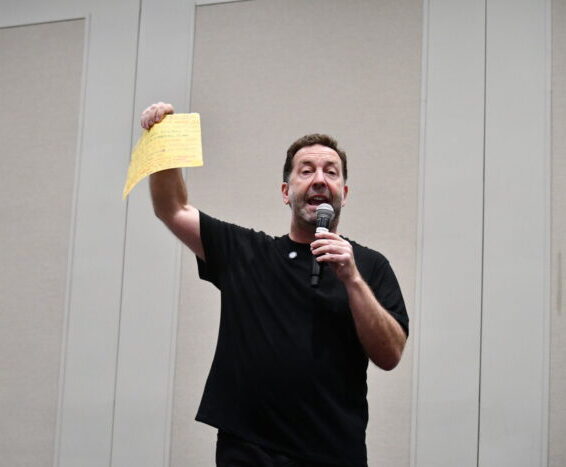
Spotlight speaker Carmen Bucci dreamed of being a professional baseball player from the age of 6. He created a goal sheet at 14, which he showed the audience, and diligently worked for the next eight years to achieve those goals, culminating with his selection to play for the San Diego Padres.
However, just before his third season, Bucci was released from the team and spun out. He had no idea what to do with his life without baseball. He started drinking and sunk into depression, anxiety, and suicidal ideation that lasted years, but he masked his despair behind a happy façade.
After years of bouncing between jobs and destructive behavior, Bucci sought therapy. During that recovery process, the therapist encouraged him to clean out his storage unit and confront the baseball memorabilia from his youth and young adulthood, including his teenage goal sheet.
Bucci suddenly realized that “everything begins with a thought.” He also understood that he had everything within him to be a star; he just had to bring it out. “We must live in the ‘now’ because we limit ourselves if we only spend time looking into the future,” he said.
“We have to decide what life we want to live, and that begins with the decision that ‘this’ is the moment that matters. We cannot change the past or create the future. We have to truly know that we can do something and not let ourselves be talked out of it by our own or others’ doubts,” he added.
Bucci cautioned against letting “wrong think,” those doubts and struggles, get in the way. People have to realize that they are not going to “get better” because that “better” is in them right now, not waiting for them somewhere in the future.
Bucci noted that researchers believe that people have 60,000 to 80,000 thoughts per day.
“However, you are not your thoughts,” he said. “You get to decide which thoughts are true for you and reframe how you think about about success and failure.”
Bucci said the recipe for success is making a commitment and then taking the actions to make that commitment a reality. “We can’t play it safe. We have to get it done, make mistakes, learn, and grow.”
YOUTH PERSPECTIVES
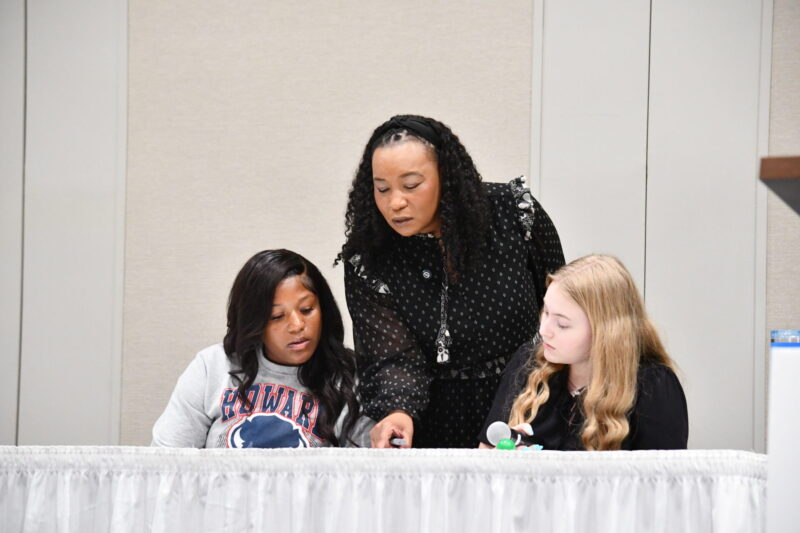
During the “You Might Be Surprised” breakout session, participants were asked to rate their perception of issues affecting youth, such as causes of teen mental health problems, teens’ biggest challenges, who teens talk to during struggles, teens’ coping mechanisms when they are down, and how teens escape from their problems.
After adults gave their ratings on each question via a phone survey app, youth survey results (from 77 respondents) for the same questions were shared, most indicating a gap in adult understanding of teens’ perspectives.
Be Well Iredell Youth panelist Iyona, a senior at Crossroads Early College, said social media was not the major factor affecting teens’ mental health, despite what many parents and adults think.
High school students are more mature and savvy and see through fake content. They block people who spread negativity or bully. However, Iyona acknowledged that middle school students are likely more influenced by the effects of social media.
Iredell-Statesville Schools Chief Student Services Officer Shayla Savage was surprised when the school district’s Youth Council chose mental health and suicide prevention as its focus. The teens have been learning how to help others who are experiencing mental health crises and to be familiar with resources to help them.
Many attendees were surprised that youths were reluctant to talk to adults in many cases. Iyona said the key for adults to connect with teens is to truly “listen to understand rather than listen to respond” as adults often do.
Savage said there was also a generational gap in attitudes toward mental health. Youths talk openly about mental health issues, but parents still experience stigma with these topics.
Surprisingly, many youth are not utilizing school counselors for assistance with mental health issues, according to Iyona, because there are too few counselors.
Counselors cannot create the personal connections needed to effectively connect with struggling students with their heavy caseloads. They are instead seen as a resource to discuss academic plans.
Several youth panel members emphasized that the most important thing parents can do when a teen comes to them with a problem is to stay calm and not take personal offense, assuming the problem is somehow related to their parenting.
Teens also said that they wanted the trusted adults in their lives “to listen to understand them, not to solve a problem.” They also said that if the adult that they confide in ”freaks out,” communication and connection will quickly end.
Teens also want the adults in their lives to uplift and support them on their chosen paths. They also want these trusted adults to make time for them and to be present and open when they are together. They crave praise for their accomplishments.
During a “Now What?” breakout session, attendees were taken through real-life scenarios and asked to identify resources to help the person in the scenario through their mental health issues and to learn the best steps for getting that person connected to support and treatment.
Many of the traditional solutions that attendees suggested would have limited effectiveness, according to youth council member Jake.
Cookie-cutter responses to situations do not work because the helper must first meaningfully connect with the person in crisis, gain trust, and build a relationship before working together to find the help the person in crisis needs.
BE WELL IREDELL
Be Well Iredell is a community collaborative working year-round to strengthen mental health awareness, suicide prevention, and access to care. The organization brings together schools, healthcare entities, nonprofits, and community partners to create a more connected, resilient community.
To learn more, contact Glaser at gglaser@uwiredell.org or visit the website at https://uwiredell.org/be-well-iredell/. The website has links to a number of seminars and classes related to mental health that can be delivered in person or virtually.