
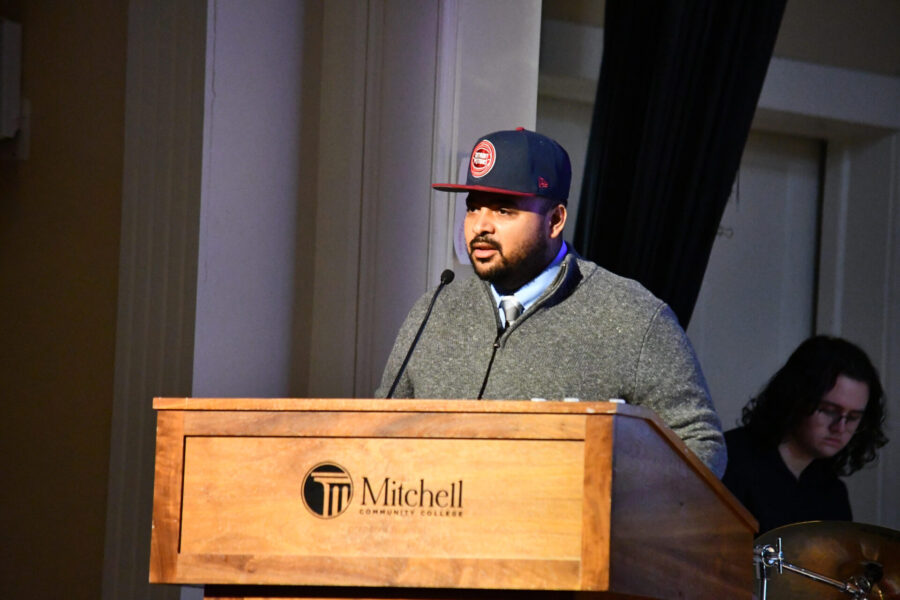
Survivor Deven Tucker shares story and struggle for hope, healing
BY DEBBIE PAGE
Project Light Rowan, a group dedicated to the eradication of human trafficking, hosted an event in collaboration with Mitchell Community College this week to bring awareness and information to the community as part of an effort to eliminate trafficking, both locally and around the world.
Mitchell Community College President Tim Brewer welcomed about 125 attendess, followed by an invocation by Pastor Curtis White and a supportive statement by N.C. Rep. Todd Carver.
Stephen Brochu, a law enforcement veteran who is now a law enforcement instructor at Mitchell, explained that human trafficking takes place in plain sight. Everyone has a role to play to end modern slavery, he said.
Quoting William Wilburforce, Brochu said: “You may choose to look the other way, but you never can say that you did not know.”
Traffickers exploit people through fraud, force, and coercion, and take away their victims’ freedom, dignity, and safety for the financial benefit of the traffickers. All of this takes place in the shadows of societal silence, misunderstanding, and disbelief in 127 countries around the world.
According to Brochu, North Carolina consistently ranks in the top 10 states with the most reported incidents of human trafficking, with sexual trafficking being the most common type. Victims are forced into sexual or labor slavery through tricks, pressure, and force.
Traffickers control victims’ ability to leave the situation and limit their freedom of movement through threats of violence, intimidation, or death against the victims and their families. Profit is the sole motivation of the trafficker.
The person can be trafficked anywhere, even in their own hometown. “Trafficking is about control, not movement,” Brochu said.
Sex trafficking involves forcing or coercing someone to performing sexual acts. Force, fraud, or coercion need not be present if the person trafficked for commercial sex is under 18 years old.
Labor trafficking occurs most commonly in restaurants and hospitality, agriculture, construction, domestic work, and manufacturing sectors. Victims are forced to work long hours in poor conditions and often have their IDs and documents taken away by the traffickers.
“Both forms of trafficking are equally real and equally damaging,” Brochu explained.
Sex trafficking often involves vulnerable teens who are manipulated by someone who gains his or her trust.
A trafficked worker may be controlled through their housing, environment, pay, and holding of documents. The victims often believe they owe a debt they have to pay off.
Though they may appear free, they are physically and psychologically trapped by the traffickers, who may be strangers, romantic partners, family members, employers, friends, or highly organized criminal trafficking networks. Victims can be of any age, gender, race, or background.
College students are at a unique intersection of both vulnerability and influence. They may be away from home for the first time, and financial stress may leave them vulnerable to exploitation. Traffickers use social media and dating apps to recruit, groom, and manipulate.
To combat trafficking, college students must stay connected and observant of those around them and notice the red flags that indicate a person is being trafficked.
These red flags can include a person who is reluctant to speak for themselves, seems fearful, or anxious, appears controlled, gives inconsistent stories about their living or work situations, appears isolated from friends and family, exhibits signs of abuse or neglect, works long hours, has few possessions, and are of out control of their money, identification or documents, or transportation.
Brochu said a pattern of these types of behaviors may indicate trafficking, and that the person who observes them should trust their instincts and report their suspicions to authorities or the National Human Trafficking Hotline.
Building trafficking cases is complex for law-enforcement officers, who must spend a lot of time building trust with victims. Local, state and federal law enforcement agencies coordinate their efforts to find the specific evidence needed for an arrest and prosecution. Social workers, nonprofits, schools, universities and colleges, health providers, and the community work together to help identify those being trafficked in their communities.
Law enforcement instructors must teach recruits how to identify both victims and traffickers and how to communicate effectively with traumatized victims to get the evidence necessary to secure a conviction in court.
Building awareness of the problem, increasing prevention efforts, and encouraging community involvement are important to eradicate human trafficking. Speaking up about trafficking, being observant, supporting survivor organizations, challenging stereotypes and misinformation, and informing the misinformed are important steps that community members can take to help.
Reaching out to help the vulnerable, isolated, or exploited people encountered in their professional or personal lives is crucial. “You may be the first person they trust. You may be the only one who saw the signs. You may be the one who changes the trajectory of someone’s life,” Brochu said.
“That responsibility is real power.”
Brochu closed with words from the late Pope Francis’s words: “Human trafficking is an open wound to the body of contemporary society. It is a crime against man,” he said.
He encouraged listeners to be aware, compassionate, and to care enough to act if they see the red flags of trafficking.
“Be the person who does not look the other way. When we choose to see, to speak, and to act, we become part of the solution,” he said.
Weston Parks, founder of The Value of One global anti-trafficking organization and a former law enforcement officer, said that human trafficking is as old as human history. Traffickers are motivated by power, profit, and control.
He founded the organization in 2020 after seeing the need for action to stop slavery, forced labor, or servitude that strips away the freedom and dignity of a human being and imposes another’s will on that person.
His organization partners with law-enforcement and nonprofit organizations to help trafficking victims, often children, rebuild their lives. However, he believes law enforcement has only scratched the surface of the massive human trafficking networks across the world.
Every community has to fight trafficking in every way they can. Quoting Margaret Mead, Parks said, “Never doubt that a small group of thoughtful, committed citizens can change the world. Indeed, it’s the only thing that ever has.”
Parks said an estimated 27 million people worldwide are being trafficked, with some estimates reaching as high as 40 million. The International Labor Organization said this data includes forced labor, and sexual exploitation.
Approximately one in four victims are children. Seventy percent are women and girls.
“This is not just happening overseas. This is happening right here in the United States, in our communities,” Parks said.
The international trafficking hotline receives thousands of trafficking reports every year, but the organization knows that many more cases go unreported.
Parks noted that traffickers are working actively to lure victims. They use manipulation, false promises, relationships, and fraud. They promise young girls careers, opportunities, love, and stability, only to strip everything away once they are under the traffickers’ control.
Using threats, fear, abuse, psychological manipulation, and isolation, traffickers convince victims they have no way out. Traffickers lock up victims’ IDs, passports, and their ability to leave by locking them in apartments, hotel rooms, and even cages to be be sold over and over again.
A child is exploited by traffickers every two minutes in the commercial sex trade, according to research.
“These are not just numbers. These are real people, real faces, real lives,” Parks said.
His organization has worked with young girls between 3 and 12 years old who have never had their own bed or had a mother or father who truly cared for them. By the time they were rescued, they had been raped or abused by grown men hundreds of times, Parks said.
His organization found a 14-year-old girl who was being sold for sex by her own mother for $200 per hour. They caught a young man trafficking 12-year-olds as commercial commodities.
“This is not unusual. This is not an exaggeration. This is the reality of human trafficking,” he said.
Parks, who has spoken with many victims of human trafficking, said that it destroys their identity, breaks families, and leaves lasting emotional and physical scars. However, he has also seen healing and hope take the place of despair when people step in and tell the victims that they matter.
Parks noted that human trafficking thrives on silence and from people who see it as someone else’s problem. He urged people to stand up for those who cannot stand up for themselves, speak for those who have been silenced, raise their voice for the victims, and be the one to make a difference for one person.
A Survivor’s Story
Trafficking survivor Deven Tucker recounted his experiences as a victim of both sexual and labor trafficking. A kid with an unstable home life, he was kidnapped and drugged at gunpoint at age 14 by a Haitian gang as he walked out of of an abandoned building in Detroit.
Tucker was trafficked across 21 states for the next nine years.
He woke up in Wisconsin and had no ID and no phone to call for help. During the day, the traffickers dressed him in a suit and made him work door-to-door sales, after which he was sex trafficked at night.
The traffickers watched Tucker 24 hours a day, and once when he tried to fight back, they placed a gun in his mouth, threatening to kill him. He saw people who stepped out of line beaten and left for dead.
Tucker said that people do not understand the psychological battle that trafficking victims suffer. He began to believe that he was a bad person and that his life was supposed to be this way. He felt like he deserved it because he had done bad things and was being punished.
He lost hope because he did not know how to escape, who he could trust, and he was controlled by threats toward his family. He felt very isolated and cut off completely, unaware of what was going on in the world around him.
In desperation, Tucker decided to pray for help. Three days later, in February of 2011, police raided the traffickers’ hotel rooms in Orlando, and he finally got his freedom. However, he suffered severe mental health issues and did not know how to function on his own.
With his poor communication skills, Tucker said he felt confused and lacked a personal identity. Suicidal, he went to therapy to overcome these challenges so that he could function more normally.
He had to overcome PTSD, which caused problems at work when he pushed against the direction and authority of employers, perceiving it as the same as the traffickers’ control. It took him five years to recover.
Tucker credits his healing to Jesus and the church, a journey begun by an FBI agent who helped him see that God loved Tucker and sent his son Jesus to save him. Step by step and day by day, Tucker worked to change his life.
Tucker urged parents to be the heroes in their kids lives, to be at home and stay involved with their kids because predators count on their victims lacking love, financial stability and the understanding of their families. They study potential victims for weak spots and exploit them.
He warned parents to be aware of their children’s social media activity because traffickers use catfishing to trap victims into modern day slavery. They set up non-responder fake accounts and act the same age as the person or child they are recruiting, studying their potential victims.
They use social media to get the victim or family’s location and start surveying them to gather information about their movements. After gathering data, they develop relationships with the victims on social media, being careful not to tag or share posts to make it more difficult for law enforcement to track them.
They sneak into their victims’ direct messages and build a relationship, which teens or children often believe are legitimate. They do not understand that traffickers are grooming them.
Tucker also warned distracted parents can lose their child in the blink of an eye in a public place. Traffickers look for children to scoop up and run.
Tucker urged people to spread the word about the dangers of human trafficking, urging them to fight back. He established the Deven Tucker Foundation to spread awareness and provide help to those rebuilding their lives after escaping traffickers.
Report any potential trafficking to the National Human Trafficking Hotline at 888-373-7888, text 233733, or chat online at humantraffickinghotline.org.
LEARN MORE
♦ For information on North Carolina hotline statistics and results, visit https://humantraffickinghotline.org/en/statistics/north-carolina.
♦ For more information on trafficking, visit https://www.dhs.gov/sites/default/files/2025-06/25_0625_bc_human-trafficking-101-v02-508.pdf.