
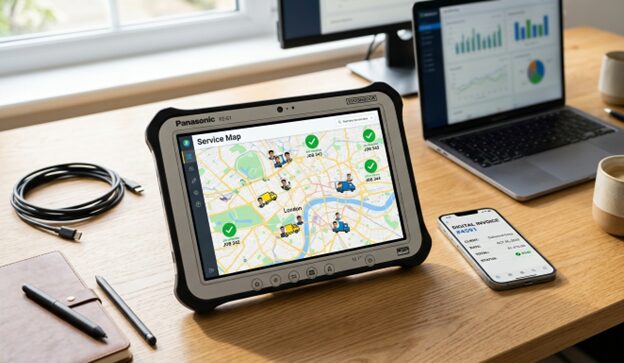
Small service providers often operate on razor-thin margins of as little as 10%, so a single lost invoice or a mismanaged technician schedule can erase a week’s profit. The solution to this volatility is no longer just “working harder” but rather the aggressive integration of field operations with back-office digital systems. When these two halves of a business communicate in real time, profitability stops being a guessing game and becomes a predictable outcome.
Image Source: Google Gemini
Profits Rise When Data Moves Fast
The primary barrier to growth for most local service businesses is the “data silo” where information is trapped on paper or in a technician’s head. Modern service firms are finding that cloud and advanced digital tech achieve 19% higher turnover per worker by eliminating the manual re-entry of job details.
There are hundreds of unbilled work orders every day in the service industry simply because a technician forgot to note an extra gallon of chemical or an additional hour of labor. Integration solves this by forcing a digital handshake between the field and the office.
When a job is marked “complete” on a mobile device, the back office sees it instantly. This removes the three-to-five-day lag time that usually kills cash flow. For a small business owner, this means your bank account reflects the work you did today, not the work you did last Tuesday.
Connectivity also reduces the overhead costs associated with “office bloat.” If your systems are integrated, you do not need three administrative assistants to chase down technicians for their paperwork. One person can manage a much larger fleet when the software handles the heavy lifting of data organization.
Reducing Errors Through Automated Billing
Human error is the silent killer of the bottom line. Every time an office staffer has to read a technician’s handwriting and type it into an accounting suite, there is a chance for a mistake. These errors lead to disputed invoices, which delay payment and frustrate customers.
A seamless workflow enables automated billing for technicians in pest control, for instance, so the invoice generated at the kitchen table matches the work performed exactly. This level of precision builds immense trust with the client base. Customers are far more likely to pay immediately when the invoice is professional, accurate, and delivered within minutes of the service.
Beyond just accuracy, there is the matter of payment speed. Recent data suggests that AI-driven invoice reminders help small businesses get paid faster than traditional manual follow-ups.
For a service provider with high fuel and labor costs, getting paid 45% faster is the difference between taking on new equipment debt or paying for it in cash. It stabilizes the company’s entire financial foundation.
The transition to automated systems requires an initial investment of time, but the return is found in the hundreds of hours reclaimed from administrative drudgery. Consider these three specific ways integrated billing changes your daily operation:
- Technicians capture digital signatures that serve as instant proof of service for insurance and billing
- Inventory levels update automatically as parts are used on a job site to prevent stockouts
- Customer payment profiles stay on file to allow for one-click processing of recurring service plans
Field Operations And Back Office Harmony
When the field and the office are out of sync, the business suffers from “leakage,” in which small amounts of revenue disappear through the cracks in every job. You might be losing 5% of your total revenue simply because your office doesn’t know exactly what happened on the job site. High-performing service companies are now using unified field-to-office operations to prevent unbilled extras and ensure every minute of labor is accounted for.
This synchronization allows for better routing and scheduling. If an office manager can see the real-time location and status of every truck, they can pivot to emergency calls without wasting fuel or time. It turns a chaotic day of phone calls into a streamlined flow of digital assignments.
Furthermore, this data creates a feedback loop for better pricing. If your integrated system shows that a specific service consistently takes 20% longer than you estimated, you can adjust your quotes immediately. Without that data, you might go years underpricing your most common jobs.
Scaling A Service Business Through Technology
Scaling a service business used to mean hiring more people to manage the people doing the work. In 2026, scaling means leveraging technology to do more with the team you already have. Small businesses using AI and automation save one day per worker weekly on administrative tasks that used to require a full-time salary.
This time savings allows the business owner to focus on strategy and growth rather than micromanaging paper trails. It moves the business from a “hustle” mindset to a professional enterprise mindset. You are no longer just a technician with a truck; you are a data-driven service provider with a scalable platform.
Integration is no longer an optional upgrade for gadget lovers. It is the baseline requirement for staying competitive in a market where customers expect instant communication and digital convenience. If your competitor can send an automated text when they are five minutes away and take a credit card payment on the spot, you cannot expect to win by mailing a paper invoice two weeks later.
Modernizing Service Workflows For Profitability
The goal of technology integration is to make the business run as if the owner were looking over every technician’s shoulder without actually having to be there. By connecting the field to the back office, you ensure that the high standards you set for your business are actually being met on every job site.
For more insights on refining your business operations and staying ahead of industry trends, our blog covers the latest strategies.